
Service
Driveway & Patio Jet WashingAcross Darlington, Durham & StocktonBring Tired Paving Back to Life for a Fraction of Replacement Cost
Deep cleaning, re-sanding and sealing that lifts years of algae and grime off block paving, sandstone and concrete, often the difference between a driveway that looks finished and one that looks abandoned.
Family run, 20 years' experience, £5 million public liability insurance and honest advice on whether cleaning or replacing is the right call for your driveway.
- 20 years' experience
- £5m public liability
- 5 year workmanship guarantee
- Free written quotes
- Driveways typically 4 days
Most Tired Driveways Just Need Cleaning, Not Replacing
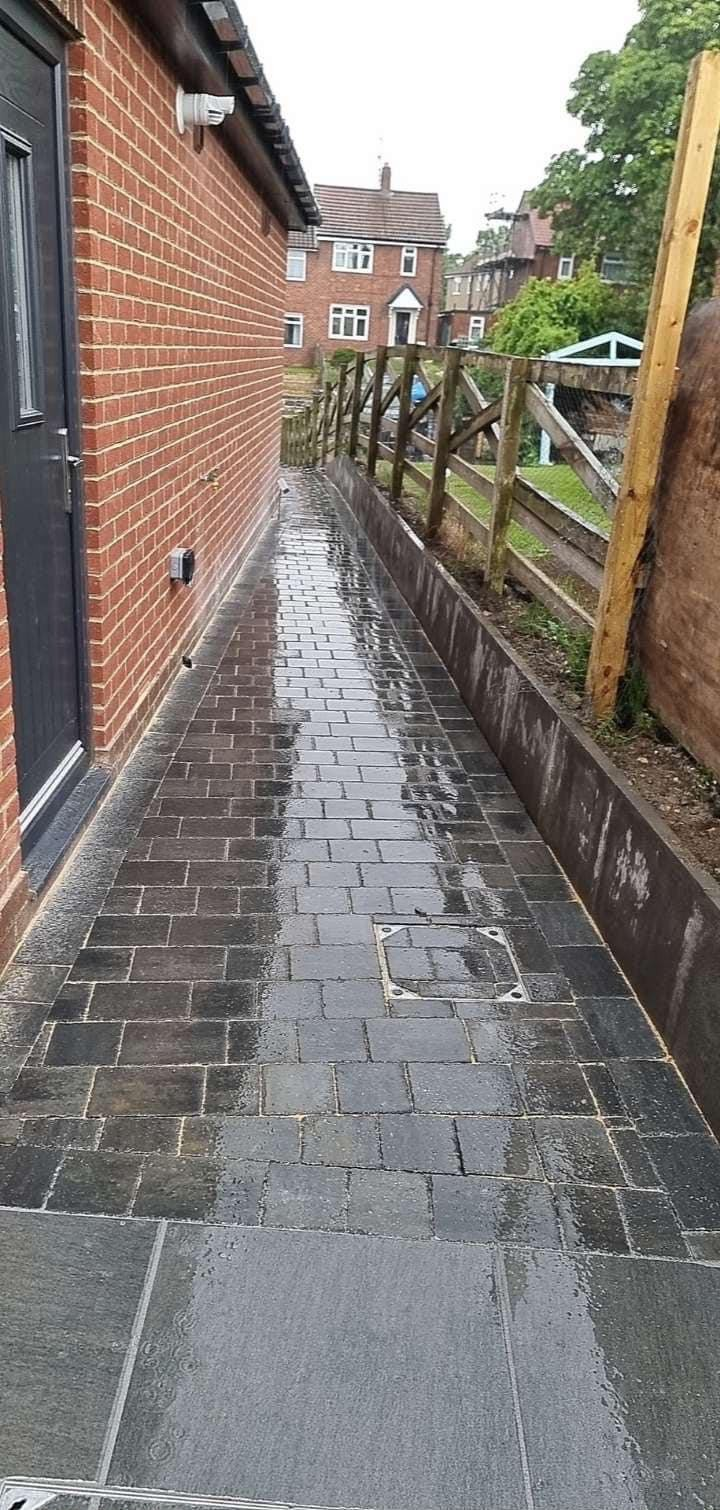
We get called out to a lot of driveways and patios that people are on the verge of ripping up and relaying, and a fair number of them don't need to be. What's actually happened is years of algae, moss, ingrained tyre marks and general grime have built up on the surface and in the joints, flattening the colour and making block paving or sandstone look grey and dead. Cleaned back properly, with the joints re-sanded and the surface sealed, the transformation is often hard to believe from the same driveway a few hours earlier.
Jet washing sounds like a simple job, and the tool itself is straightforward, but the pressure, nozzle and technique used need to match the material. Too much pressure on soft sandstone or old, worn block paving strips the surface, opens up hairline damage and blasts the jointing sand straight out of the gaps, which then need re-sanding anyway, at extra cost, to stop the whole surface loosening off. We match pressure and approach to what's actually there, not a single default setting run over everything.
We cover driveway and patio cleaning across Darlington, Durham, Stockton, Northallerton, Newcastle, Hartlepool, Sunderland, Bishop Auckland and Richmond, taking on jobs from York up to Newcastle and across to Penrith. If a drive genuinely has reached the end of its useful life, sub-base failure, spreading blocks, cracked and lifting slabs, we'll say so plainly rather than clean it and let you find out the hard way, but a clean, re-sand and seal is very often the more honest and considerably cheaper recommendation.
Based in Fishburn and working right across County Durham, Teesside and North Yorkshire. See recent projects or read how we work.
Who it's for
- Block paved driveways that have gone grey, patchy or slippery with algae
- Sandstone or concrete patios that have lost their original colour
- Anyone selling a property and wanting the frontage to look its best
- Homeowners noticing weeds and moss taking hold between joints
- Driveways where jointing sand has washed or worn away over time
When it's usually needed
- The driveway looks noticeably darker or greener than when it was laid
- Joints between blocks or slabs are gappy, weedy or losing their sand
- The surface feels slippery underfoot, especially in wet or shaded areas
- You're preparing a property for sale or a change of tenancy
- It's been several years since the surface was last cleaned or sealed
The cost of leaving it
What happens when jet washing is put off
Letting algae and moss build up unchecked
Left untreated, algae and moss don't just look bad; they hold moisture against the surface, make paving genuinely slippery in wet weather, and can accelerate weathering on softer stone over several seasons.
Jointing sand washing or wearing out completely
Once jointing sand between block paving drops below a certain level, the blocks lose the lateral support that stops them creeping and spreading under vehicle weight, which is how a clean maintenance job turns into a structural repair.
DIY pressure washing at the wrong setting
A hired pressure washer set too aggressively for the material can strip the surface finish off sandstone, blast sand out of joints in one pass, and in some cases etch patterns into softer stone that don't come back out.
Ignoring the signs a driveway actually needs replacing
Cleaning a driveway that has genuine sub-base failure, spreading edges or cracked, sinking slabs only masks the problem for a short while. We'll tell you honestly if that's what's going on rather than clean it regardless.
Mistakes we're called out to fix
- - Using a domestic pressure washer at full power on soft sandstone or aged block paving
- - Cleaning the surface but skipping re-sanding, leaving joints open to weeds and further sand loss
- - Sealing a driveway while it's still damp, trapping moisture under the sealant
- - Treating moss and algae with bleach rather than a proper biocide, which often returns faster
- - Assuming a driveway needs full replacement when a clean and re-sand would have restored it
- - Leaving cleaning so long that ingrained staining becomes permanent rather than surface-level
Our process
How your jet washing job runs, step by step
- 01
Assessment and honest recommendation
We look at the material, the condition of the joints and sub-base, and the extent of algae, moss or staining, and tell you plainly whether cleaning will restore it or whether the underlying structure needs attention first.
- 02
Written quote
A clear price is provided with no cost and no obligation, covering cleaning, joint clean-out, re-sanding and sealing as applicable to your driveway or patio.
- 03
Pre-treatment of moss, algae and weeds
Biocide treatment is applied ahead of pressure washing to kill off moss and algae at the root rather than just blast it off the surface, reducing how quickly it returns.
- 04
Pressure washing matched to the material
Pressure and nozzle technique are set for the specific surface, robust concrete block paving can take more than aged natural stone, so the clean lifts grime without damaging the surface or stripping joints.
- 05
Joint clean-out and re-sanding
Where jointing sand has washed out or is contaminated with weed growth, joints are cleaned out and refilled with kiln dried sand, locking the paving back together properly.
- 06
Sealing and final clean down
Where sealing is agreed, it's applied once the surface is fully clean and dry, and the whole area is given a final rinse and clean down before we finish up.
What you get
The difference a properly built job makes
A fraction of the cost of a new driveway
Cleaning, re-sanding and sealing a sound but tired driveway typically costs considerably less than excavating and relaying it, and can add several more good years to a surface that's structurally fine.
Colour and detail restored, not just surface dirt removed
Correctly matched pressure washing lifts ingrained algae and grime out of the texture of block paving and stone, restoring the original colour rather than leaving a patchy, half-cleaned finish.
Joints locked back up with fresh sand
Re-sanding with kiln dried sand restores the lateral support between blocks that stops them creeping or spreading, and closes off the gaps weeds use to establish themselves.
Sealing adds ongoing protection
A sealant applied to clean, dry paving helps resist future staining from oil, tyre marks and de-icing salt, and can make the surface noticeably easier to keep clean going forward.
Honest advice, not an upsell
If your driveway genuinely needs replacing rather than cleaning, we'll say so rather than take the cleaning job and let you discover the underlying problem later.
Technique matched to the material
Softer stone and older block paving are treated more gently than robust modern concrete paving, so the clean improves the surface without accelerating wear.
How Pressure Washing Differs by Surface Material
Block paving, whether concrete or clay, is generally the most forgiving surface to pressure wash because it's manufactured to a consistent density and hardness, but even here technique matters: too tight a nozzle angle held too close for too long in one spot can etch the surface or blast the chamfered edges. Concrete block paving typically handles higher pressure than clay pavers, which can be slightly softer and more prone to surface damage if the setting isn't dialled back.
Natural sandstone is a different matter entirely. It's a riven, relatively soft stone with a naturally textured surface, and excessive pressure held too close will strip that texture, open up the stone's natural grain and in some cases leave visible lines or patches where pressure was uneven across a pass. We use lower pressure, wider fan nozzles and take more time on sandstone specifically because the surface finish, once damaged, generally can't be restored; it has to be accepted or the slab replaced. Concrete slabs and pattern imprinted concrete sit somewhere in between, generally more robust than sandstone but capable of surface damage if a sealed or coloured finish is blasted too aggressively.
Re-Sanding: Why It Matters as Much as the Clean
Kiln dried jointing sand does more structural work in a block paved driveway than most people appreciate; it locks each block against its neighbours so that vehicle weight is spread sideways across the whole surface rather than each block bearing load independently. Once that sand washes, sweeps or wears away below a certain level, blocks can start to move individually, which shows up as slight creep, edges lifting, or a rocking feeling underfoot in the worst-affected areas.
Pressure washing, even done carefully, will remove some jointing sand simply because water finds its way into the joints during cleaning, and weed growth in the joints has usually already displaced some sand before cleaning even starts. That's why re-sanding is built into a proper clean rather than treated as a separate optional extra: cleaning without re-sanding often just exposes empty joints that then fill with weeds again within a season. Fresh kiln dried sand, brushed in and settled properly, restores both the appearance and the structural interlock of the paving.
When Sealing Is Worth It, and When It Isn't
Sealing a driveway or patio after cleaning isn't compulsory, but it does two useful things: it enhances and protects the colour that's just been restored by cleaning, and it makes the surface more resistant to future staining from oil drips, tyre marks and de-icing salt over winter. Sealed block paving and sandstone also tend to need less frequent deep cleaning going forward, because dirt sits on top of the sealed surface rather than working its way into the stone or block itself.
Where we'd advise against it, or at least flag it for a proper conversation, is on surfaces that are already showing structural problems: sealing over a driveway with spreading joints, failing sub-base or badly cracked slabs just locks in a problem that's going to need addressing properly regardless. It's also worth knowing that sealant needs the surface to be fully dry before application, and that some sealants can slightly darken natural stone, which is a look some homeowners want and others don't, so we'll talk through samples or examples before committing you to it.
Recognising When Cleaning Isn't Enough
Not every tired-looking driveway is a cleaning job, and we'd rather tell you that upfront than take the work and leave you disappointed. Signs that point towards a structural problem rather than a surface one include blocks visibly spreading or sinking at the edges, slabs that rock or crack under weight rather than simply looking discoloured, and standing water that pools in the same spot regardless of how clean the surface is: that's usually a sub-base or falls issue that cleaning can't touch.
If we get to a property and see genuine sub-base failure, we'll explain what we're seeing, why cleaning won't resolve it, and what a proper repair or replacement would involve, with a separate written quote for that if you want to go ahead with it. There's no advantage to us in cleaning a driveway that needs replacing; it just means a dissatisfied customer finding out the hard way a few months later, which isn't how we want to be recommended to neighbours and family.
Straight answers
Jet Washing questions
Get a Free, Written Cleaning Quote
Send us a photo or arrange a visit and we'll tell you honestly whether a clean, re-sand and seal will bring your driveway or patio back, and what it involves. Call 07909 773829, 7am to 6pm Monday to Saturday.