
Service
Artificial Grass Installationin Darlington, Durham & StocktonA Level, Green Lawn Every Month of the Year
Artificial grass laid over a properly compacted, free-draining base with edges and joints done right, so it stays flat, drains fast and looks like grass rather than a green mat.
Family run, 20 years' experience, £5 million public liability insurance and a 5 year workmanship guarantee on the base build-up and installation.
- 20 years' experience
- £5m public liability
- 5 year workmanship guarantee
- Free written quotes
- Driveways typically 4 days
Where a Real Lawn Struggles, Artificial Grass Earns Its Keep
Artificial grass isn't the right answer for every garden, but where it fits it solves problems a real lawn genuinely can't: shaded north-facing gardens that never grow grass properly, family gardens that see heavy daily use and end up as mud by October, dog runs that turn into a bog every winter, and small courtyard spaces where mowing a patch the size of a rug never made sense in the first place. Laid properly, it stays level, drains fast after rain, and looks the same shade of green in February as it does in July.
The part that decides whether an artificial lawn looks good for fifteen years or starts looking tired and lumpy within two is entirely below the surface. We strip the existing turf and topsoil, lay a weed-suppressant membrane, build a compacted free-draining sub-base, and screed a sand blinding layer over the top to get a true, even level before the grass ever goes down. Skip any one of those steps and you get the classic complaints: puddling after rain, dips where the ground has settled, or grass that shifts underfoot because it was laid straight over unprepared soil.
We install artificial grass across Darlington, Durham, Stockton, Northallerton, Newcastle, Hartlepool, Sunderland, Bishop Auckland and Richmond, and take on projects from York up to Newcastle and across to Penrith. We tie the grass into existing paving, sleeper beds and paths so the finished levels sit flush, with no trip-hazard lip at the edges, and joints are set out, glued and taped so they disappear into the lawn rather than showing as a seam down the middle.
Based in Fishburn and working right across County Durham, Teesside and North Yorkshire. See recent projects or read how we work.
Who it's for
- Gardens with heavy shade where real grass struggles to establish or thicken up
- Households with dogs where mud and worn patches are a constant issue
- Families wanting a usable, low-maintenance lawn for children to play on
- Small courtyard or side-return spaces too tight to mow sensibly
- Anyone tired of the ongoing cost and time of mowing, feeding and reseeding
When it's usually needed
- The existing lawn is patchy, waterlogged or won't establish in shaded areas
- Muddy patches appear every winter regardless of reseeding effort
- You want a low-maintenance solution ahead of selling or letting a property
- A dog run or play area needs to stay usable and mud-free year-round
- A small or awkwardly shaped lawn area makes mowing more hassle than it's worth
The cost of leaving it
What happens when artificial grass is put off
Laying grass straight over existing soil or turf
Artificial grass laid without proper ground preparation traps moisture underneath, leading to puddling, an unpleasant smell over time, and a soft, spongy feel underfoot that never firms up.
No free-draining base beneath the grass
Without a compacted, permeable sub-base, water has nowhere to go and sits at the base of the grass backing, which shortens the life of the product and is especially problematic for dog owners needing the area to dry quickly.
Poorly finished joints and edges
Joints that are pinned through the face rather than glued and taped underneath, or edges left loose without proper fixing, are the most common giveaway of a rushed installation and the first thing to fail or peel.
Inconsistent pile direction across the lawn
Artificial grass has a directional pile, and mixing directions between rolls creates a visible colour or shade difference across the lawn that's very hard to correct after installation.
Mistakes we're called out to fix
- - Skipping membrane installation, which allows weeds to grow up through the base and grass
- - Using an insufficient depth of sub-base, leading to soft spots and settling within a year or two
- - Not screeding the sand blinding layer level, resulting in a bumpy or uneven finished lawn
- - Cutting corners on edging, leaving the perimeter of the grass loose and prone to lifting
- - Choosing pile height purely on price without considering intended use, such as heavy dog or child traffic
- - Failing to plan drainage falls, particularly for gardens near a boundary wall or fence
Our process
How your artificial grass job runs, step by step
- 01
Site visit and product selection
We assess the area, drainage, shade and intended use, family play, dog run, low-traffic ornamental lawn, and talk through pile height and product options suited to that use.
- 02
Written quote
A clear, itemised price follows covering excavation, base build-up, materials and installation, with no cost and no obligation attached.
- 03
Turf strip and excavation
Existing turf and topsoil are stripped out and removed, and the area excavated to the depth needed for a proper free-draining base build-up.
- 04
Membrane, sub-base and sand blinding
Weed-suppressant membrane is laid, followed by a compacted free-draining stone sub-base, then a sand blinding layer screeded flat to create a true, even level for the grass.
- 05
Edging, laying and jointing
Perimeter edging is fixed to give the grass something secure to be fastened to, the grass is rolled out with pile direction kept consistent, and joints are glued and taped from beneath rather than pinned through the face.
- 06
Infill, brushing and finishing
Sand or rubber infill is applied where specified to help the blades stand upright and add weight, the lawn is brushed up, and the area is cleaned down before we finish.
What you get
The difference a properly built job makes
Green and level all year round
No dead patches in shade, no muddy winter ruts, and no yellowing in a dry summer: the lawn looks the same in any season and any weather.
Free-draining base that copes with dogs and heavy use
A properly built permeable sub-base lets water and urine drain through quickly rather than sitting on the surface, which matters for both hygiene and how usable the lawn is after rain.
No mowing, feeding or reseeding
Maintenance drops to an occasional brush and rinse and clearing autumn leaves, removing the recurring weekly time and cost of maintaining a real lawn.
Flush transitions into existing paving
We tie the finished grass level into patios, sleeper beds and paths so there's no trip-hazard lip at the edges, and the garden reads as one considered space.
Consistent pile direction and invisible joints
Careful set-out means seams fall in the least visible places and are glued and taped rather than pinned, so the lawn looks continuous rather than showing joint lines.
5 year workmanship guarantee
If the base settles or the installation fails within five years due to how it was built, we come back and put it right, backed by our £5 million public liability insurance.
Why the Base Build-Up Determines the Result
It's tempting to think of artificial grass installation as simply rolling out a product, but the base underneath does almost all the work that determines whether the finished lawn performs well. After stripping the existing turf and topsoil, we lay a weed-suppressant membrane to stop anything growing up from below, then build a compacted, free-draining stone sub-base to a depth appropriate for the ground conditions and intended use: a lawn for occasional ornamental use needs less depth than one that's going to take daily dog traffic or children's play equipment.
On top of the compacted sub-base we screed a layer of sharp sand, sometimes called a blinding layer, to a true, consistent level. This is what actually determines the flatness of the finished lawn: any dips or high spots in this screeded layer will telegraph straight through the grass once it's laid, because the material itself is flexible and simply follows whatever is underneath it. Getting this level right, checked with a straight edge across the whole area rather than by eye, is one of the parts of the job that's invisible in the finished result but entirely responsible for whether that result looks right.
Choosing Pile Height and Product for the Right Use
Artificial grass products vary considerably in pile height, density, colour blend and backing construction, and the right choice depends heavily on how the lawn will actually be used rather than which looks best in a sample swatch. A shorter, denser pile suits areas with heavy foot traffic, children's play or dogs, because it recovers its shape faster and shows wear less than a longer, more luxurious pile that's better suited to ornamental areas seen but not walked on constantly.
For households with dogs specifically, we'd usually steer towards a product with good drainage performance through the backing itself, not just the base beneath it, because urine needs to pass through quickly rather than sit at surface level. Colour blend matters too: most modern artificial grass mixes two or three shades of green with some brown or straw-coloured fibres worked through to avoid the flat, uniform look that made early artificial lawns easy to spot from a distance. We'll bring samples and talk through the practical trade-offs for your specific garden and household rather than default to whichever product is cheapest.
Joints, Edges and the Details That Show
Where two rolls of artificial grass meet is the single most common giveaway of a poor installation, and it's almost entirely down to technique rather than the product itself. We set out joints to fall in the least visible position relative to how the lawn is typically viewed, keep pile direction consistent across every roll so there's no shading difference either side of the seam, and join the rolls using adhesive and jointing tape applied from beneath rather than pinning or stapling through the face of the grass, which shows and can work loose over time.
Perimeter edging matters just as much as the joints. Grass with no secure fixing at the edges lifts, curls and gets pulled by mowers or strimmers working an adjacent lawn area, and eventually needs refixing. We install proper edging, timber, composite or metal depending on the situation, around the full perimeter so the grass has something solid and permanent to be fastened to, and this is also where we tie the finished level into adjoining paving or borders so there's no step or trip hazard where the two meet.
Ongoing Maintenance and Realistic Lifespan
One of the genuine appeals of artificial grass is how little ongoing work it needs compared with a real lawn, but that doesn't mean zero maintenance forever. An occasional brush against the direction of lay helps keep the blades standing upright, particularly in areas that see concentrated foot traffic like a route to a gate or shed, and a rinse down after periods of heavy pollen or in gardens with dogs helps keep it fresh. Autumn leaf fall should be cleared reasonably promptly, since leaves left to decompose on the surface can leave organic matter that's more work to remove later than if it's brushed off regularly.
With a properly built base and a reasonable quality product, artificial grass typically performs well for well over a decade, with UV-stable fibres resisting fading from sun exposure across that time. What actually shortens a lawn's usable life in practice is almost always a base problem rather than the grass wearing out: settling, poor drainage or a base that was never built to handle the traffic the lawn actually gets. That's exactly why the preparation stage gets as much attention from us as the visible grass itself.
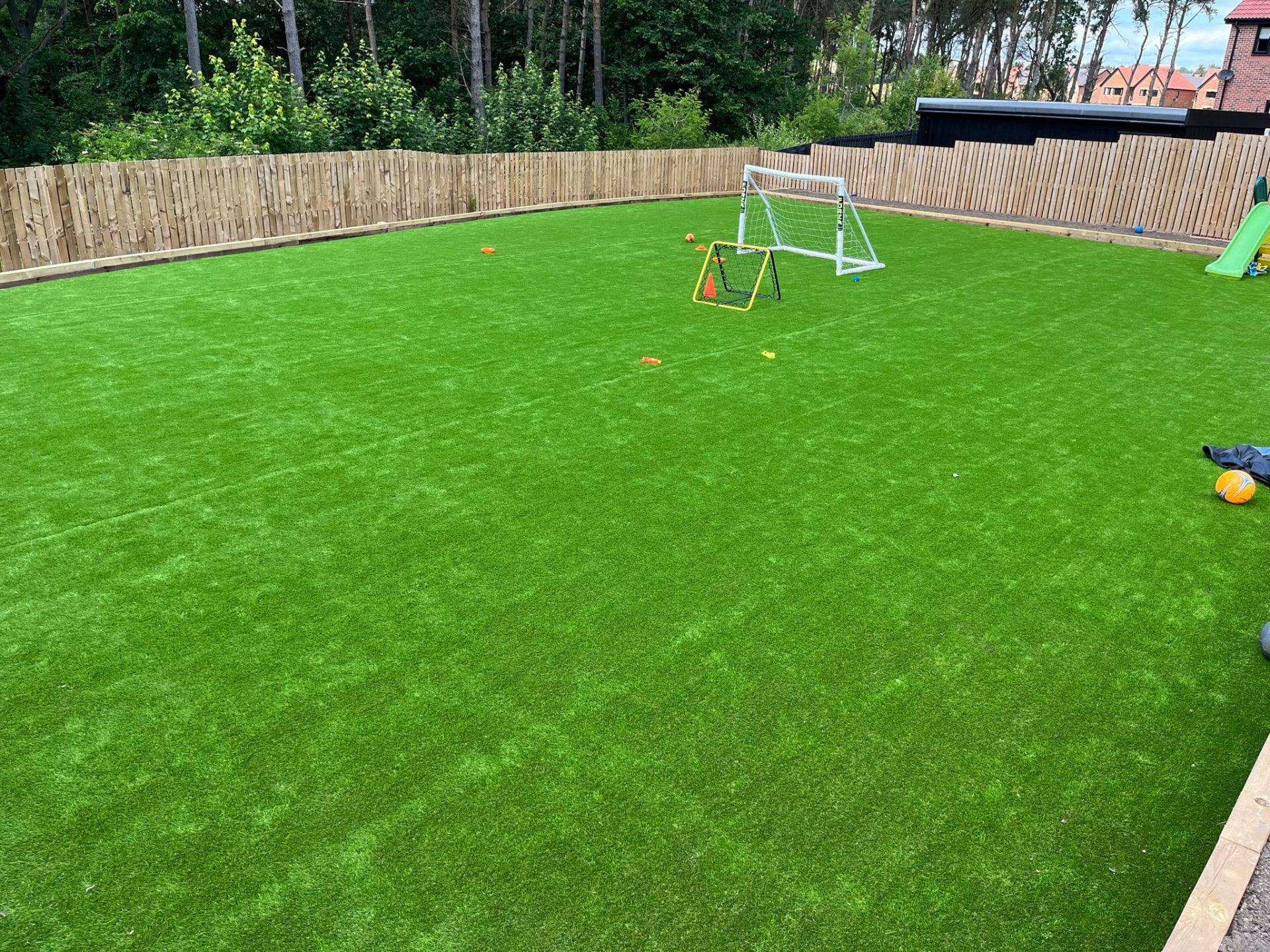
Artificial Grass across the North East
Straight answers
Artificial Grass questions
Get a Free, Written Artificial Grass Quote
Tell us about the space, whether it's a dog run, a family garden or a small courtyard, and we'll visit, measure up and send a clear written price with no obligation. Call 07909 773829, 7am to 6pm Monday to Saturday.