
Service
Fencing & Boundary InstallationDurham, Darlington & StocktonPosts Set Right, Lines Set Straight
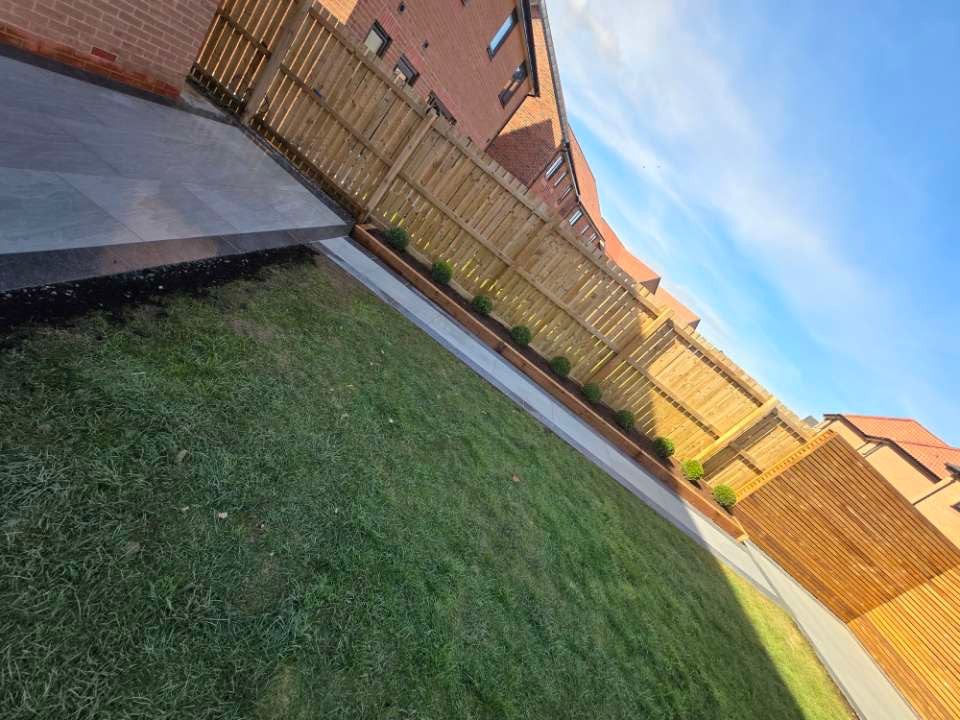
Fencing installed to line and level, with posts set properly in concrete at the correct depth, so the run stays straight and upright for years rather than leaning within a season.
Free written quote, no obligation. 20% deposit secures your date. £5 million public liability insurance and a 5 year workmanship guarantee on every job.
- 20 years' experience
- £5m public liability
- 5 year workmanship guarantee
- Free written quotes
- Driveways typically 4 days
Fencing that stands up to County Durham weather because the posts are done properly
A fence almost never fails at the panel. It fails at the post: either set too shallow, packed with rubble instead of concrete, or spaced too far apart for the panel and wind loading involved. Once a post starts to lean, the whole section it supports leans with it, and no amount of straightening the panel on top fixes a post that was never properly founded in the first place.
We set every post in concrete at a depth appropriate to the fence height and the ground conditions, working the run to line and level even across sloping gardens where panels need to be stepped or raked to follow the fall of the land properly. That attention at the post stage is what separates a boundary that still looks straight in five years from one that needs propping up after the first winter storm.
As a family-run business covering Durham, Darlington and Stockton, we install close board, feather edge, panel and post-and-rail fencing, along with gates and trellis toppers, and because we also lay driveways and patios we can coordinate fencing with wider groundworks, levels and drainage rather than treating it as a job that happens in isolation from everything else in the garden.
Based in Fishburn and working right across County Durham, Teesside and North Yorkshire. See recent projects or read how we work.
Who it's for
- Homeowners replacing a leaning, rotten or storm-damaged boundary fence
- New build owners needing boundary fencing installed as part of landscaping the garden
- Households wanting increased privacy or security with a taller close board or feather edge fence
- Rural and semi-rural properties needing post-and-rail fencing for paddocks, gardens or field boundaries
- Anyone combining a new driveway or patio project with matching new fencing and gates
When it's usually needed
- An existing fence has started to lean, and one or more posts have rotted or worked loose at the base
- Storm damage has brought down panels or snapped posts and the boundary needs rebuilding
- A new driveway or landscaping project is underway and the fencing needs to be replaced or extended to match
- Increased privacy or noise screening is wanted between neighbouring properties
- A gate needs installing or replacing to give secure, functional access to a driveway or garden
The cost of leaving it
What happens when fencing is put off
Posts set too shallow or packed with rubble
A post that is not set deep enough, or bedded in rubble and hardcore instead of poured concrete, will work loose within a year or two under wind loading, especially on taller close board or feather edge panels that catch a lot of wind.
Ignoring sloping ground
Fitting standard panels straight across a sloping garden without stepping or raking them leaves gaps under the fence at the low end, which undermines both the look of the boundary and its usefulness for privacy, security or containing pets.
Rotten timber left in place under new panels
Reusing old, partially rotten posts to save cost, or leaving old concrete post stumps in the ground, sets a new fence up to fail early, since the new panels are only as sound as whatever they are fixed to.
Gates fitted without adequate post support
A gate puts repeated leverage on its hanging post every time it opens and closes. A post that is fine for a fence panel but under-sized or shallow for a gate will lean within months, leaving the gate dragging or refusing to close square.
Mistakes we're called out to fix
- - Choosing panel style purely on appearance without considering wind exposure or privacy needs
- - Reusing old posts or concrete bases to save cost rather than starting with sound foundations
- - Not accounting for slope, resulting in stepped panels being fitted flat and leaving gaps underneath
- - Underestimating post depth and concrete needed for taller fencing or exposed, windy sites
- - Fitting a gate onto a post sized for fence panels rather than one built to handle repeated leverage
- - Leaving old fencing and post bases in the ground rather than removing them properly before starting again
Our process
How your fencing job runs, step by step
- 01
Site visit, measure-up and free written quote
We walk the boundary line, check ground conditions, note any slope, gates or access needs, discuss panel style and height, and provide a clear written quote with no cost and no obligation.
- 02
Removal of old fencing
Existing panels, posts and any old concrete bases are removed and taken away, leaving a clean line to work with rather than building around old foundations.
- 03
Setting out to line and level
The new run is marked out and post positions set to the correct spacing for the panel type chosen, working to line and level even where the ground slopes.
- 04
Posts set in concrete
Posts are set at a depth appropriate to fence height and ground conditions and set in poured concrete, not packed rubble, giving the run a foundation that will hold under wind loading.
- 05
Panels, gates and trellis fitted
Panels are fitted level or stepped and raked as the ground requires, gates hung square on adequately supported posts, and any trellis toppers fitted to the finished height.
- 06
Site cleared on completion
Off-cuts, packaging and any remaining waste are cleared away, leaving the finished boundary and the surrounding garden tidy.
What you get
The difference a properly built job makes
Posts set properly in concrete
Every post is set at the correct depth in poured concrete rather than packed rubble, giving the fence the foundation it needs to stay upright under wind loading for years.
Runs set to line and level across sloping ground
Panels are stepped or raked to follow the fall of the land where needed, so there are no unsightly gaps at the base and the boundary reads as a deliberate, finished job.
Old fencing removed and disposed of
Rotten panels, posts and old concrete bases are dug out and taken away rather than left in the border or reused where they should not be.
Gates hung square and supported properly
Gate posts are sized and set to handle the repeated leverage a working gate puts on them, so the gate keeps closing square rather than dragging within months.
Coordinated with driveways and landscaping
Because we also carry out driveways and patios, fencing can be planned alongside levels, retaining structures and drainage rather than being an afterthought that another trade has to work around.
5 year workmanship guarantee
Every fencing installation carries the same 5 year workmanship guarantee as our driveway work, backed by £5 million public liability insurance.
Why post depth and concrete matter more than panel quality
It is tempting to focus on panel quality when choosing a new fence, but the panel is the part that is easiest to replace if it fails. The post is what everything hangs off, and a post that is set too shallow, or bedded in loose rubble rather than poured concrete, will start to move under wind loading long before the timber itself shows any sign of wear. Taller close board and feather edge panels in particular catch a significant amount of wind, and County Durham's exposed, open sites see their fair share of it.
We set posts to a depth appropriate for the fence height and the ground conditions on site, using poured concrete rather than compacted rubble or hardcore. On more exposed sites, or where fencing runs along a boundary that takes the worst of the prevailing wind, we increase post spacing support or depth accordingly rather than applying a single approach regardless of exposure.
Working with slopes, uneven ground and existing boundaries
Very few gardens are perfectly flat, and a fence installed without accounting for slope either leaves gaps under the panels at the low end or forces awkward, uneven panel heights along the run. We set the run out to line and level first, then either step the panels, installing them level but at slightly different heights along the slope, leaving small triangular gaps at each post, or rake them, angling the panel itself to follow the slope continuously. Which approach suits a particular boundary depends on the panel type, the severity of the slope and the look wanted.
Where a new fence is replacing an old one, we remove the existing structure fully, including any old concrete post bases left in the ground, rather than trying to build around them. Leaving old foundations in place might save time on the day but it constrains where new posts can go and often means compromising on spacing or line just to avoid digging out old concrete.
Panel types, timber options and choosing the right style
Close board fencing, built from overlapping feather edge boards fixed to horizontal arris rails between posts, gives a solid, private and durable boundary that suits most residential gardens across Durham, Darlington and Stockton. Panel fencing, using pre-made lattice, waney edge or featheredge panels, is quicker to install and more cost-effective, suiting boundaries where budget and speed matter more than the very longest lifespan. Post-and-rail fencing suits paddocks, field boundaries and more rural settings where containing livestock or marking a boundary matters more than privacy.
Timber posts are the standard choice and, set correctly in concrete, give a long service life, while concrete posts are available where longevity and low maintenance matter more than appearance, often used alongside timber panels to combine the strength of concrete with the look of a timber fence line. Trellis toppers can be added to increase height for privacy or to support climbing plants without needing a full extra panel height in solid timber.
Gates and how they change what a post needs to do
A gate puts a very different demand on its supporting post compared with a fence panel. Every time a gate opens and closes, it applies leverage to the hanging post, and over thousands of openings that leverage will find any weakness in how the post was set. We size and set gate posts specifically for this, using appropriately sized concrete-set posts capable of taking the repeated load without gradually leaning out of square.
We fit gates including all necessary ironmongery, hinges, latches and closers where wanted, and make sure the gate hangs level and closes squarely against its post from day one, rather than needing adjustment within the first few months of use.
Straight answers
Fencing questions
Get a free, written quote for your fencing and boundaries
We cover Durham, Darlington, Stockton, Northallerton, Newcastle, Hartlepool, Sunderland, Bishop Auckland and Richmond, with jobs completed from York up to Newcastle and across to Penrith. Call 07909 773829, 7am to 6pm Monday to Saturday, and we will arrange a visit, measure the boundary and send a clear written quote with no obligation.